At some point, almost every business tries to handle UI/UX on its own.
It makes sense in the beginning. You want to move fast, save costs, and keep control. With so many tools available today, designing screens or building interfaces feels more accessible than ever.
Templates are ready. Tools are simple. Inspiration is everywhere.
So the thinking becomes simple.
“We can handle this.”
And for a while, it works.
Until it doesn’t.
Over the last few years, design tools have become more user-friendly than ever. Platforms like Canva, Figma templates, drag-and-drop builders, and no-code tools have made it easier for non-designers to create something that looks decent.
This has created a new mindset among businesses.
If it looks good, it should work.
But UI/UX is not just about how something looks. It’s about how it works, how it feels, and how easily users move through it.
That’s where DIY begins to fall short.
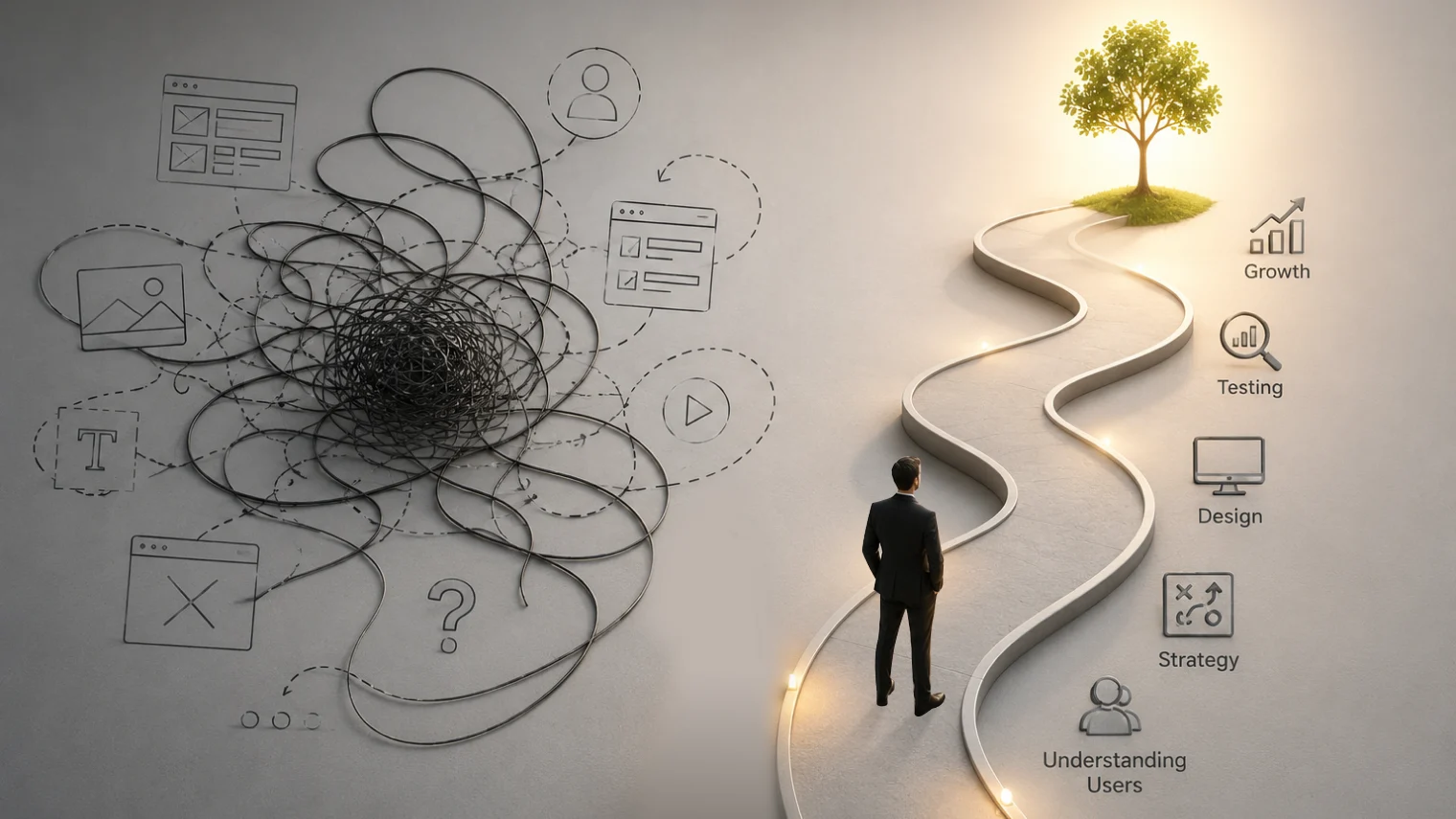
There is a big difference between creating screens and creating experiences.
DIY design focuses on output:
Expert UI/UX focuses on outcomes:
The problem is, output is visible. Outcome is not.
So businesses often feel like they are doing things right, even when users are struggling.
One of the biggest traps of DIY UI/UX is visual satisfaction.
You create something that looks polished. The colors work. The layout feels balanced. The fonts look modern.
Internally, it feels like progress.
But users don’t judge design the same way.
They ask different questions:
A product can look good and still fail completely in usability.
And that’s where businesses start losing users without understanding why.
Let’s look at where things begin to go wrong.
When you design your own product, you already know how it works. That makes it harder to see where users might struggle.
What feels obvious to you might be confusing to someone new.
Experts design with distance. They question assumptions. They look at flows from a fresh perspective.
DIY rarely does that.
Without structured UX thinking, businesses often try to include everything at once.
More features. More options. More information.
Instead of helping users, this creates friction.
Users don’t want everything. They want clarity.
Experts simplify journeys. DIY often complicates them.
The first few minutes of user interaction matter the most.
DIY approaches often treat onboarding as a basic step instead of a critical experience.
Too many inputs.
Unclear instructions.
No guidance.
Users drop off before they even understand the value.
When UI/UX is handled without a system, inconsistency creeps in.
Different styles.
Different tones.
Different flows.
This affects trust.
Users may not notice it consciously, but they feel it.
Experts build systems. DIY builds pieces.
UI/UX is deeply connected to business goals.
Every design decision should guide users toward an action.
Sign up.
Purchase.
Explore.
Engage.
DIY often focuses on creating pages, not guiding behavior.
Experts design for action.
At first, DIY feels cost-effective.
No agency fees.
No external dependency.
But over time, the cost becomes visible in other ways.
You spend more bringing users in, but fewer users stay.
That gap is expensive.
Most businesses don’t ignore UX intentionally.
They delay it.
“We’ll fix it later.”
“Let’s grow first.”
“We’ll invest once we scale.”
But growth rarely happens before clarity.
If users don’t understand your product, scaling only amplifies the problem.
Fixing UX later is always more expensive than doing it right early.
A UI/UX expert doesn’t just design screens. They solve problems.
They:
They know what to remove, not just what to add.
That’s what makes the difference.
Today, users don’t compare features alone.
They compare experiences.
Two products can offer the same functionality.
But the one that feels easier wins.
Not because it’s better technically, but because it’s better experientially.
That’s where experts create real value.
DIY UI/UX is not wrong.
It’s a phase.
It helps you start. It helps you move quickly.
But as your business grows, expectations change.
Users expect clarity.
They expect speed.
They expect consistency.
And DIY struggles to keep up with that.
What worked at 50 users doesn’t work at 5,000.
At some point, every growing business needs to shift from:
Doing things themselves
to
Doing things right
This is not about losing control.
It’s about bringing in the right expertise to support growth.
It’s about building something that works not just for you, but for your users.
When UI/UX is handled by experts, things start to change.
Users understand faster.
Journeys feel smoother.
Decisions feel easier.
Trust builds naturally.
You don’t have to convince users as much.
The product does it for you.
Many businesses think UI/UX is a design function.
It’s not.
It’s a business function.
It affects:
Good UX doesn’t just improve aesthetics.
It improves outcomes.
If your product is growing, the answer is simple.
Yes.
Not because you can’t design.
But because your business deserves better than trial and error.
Because your users deserve clarity.
Because growth depends on experience.
At RarePixels, our UI/UX design team is not treated as a layer added at the end. It is approached as a core part of how a business connects with its users. The focus is not just on making things look good, but on making them work effortlessly.
By combining deep user understanding, structured design thinking, and strong execution, RarePixels helps businesses move beyond DIY limitations and build experiences that are clear, scalable, and aligned with real goals.
Because in today’s digital space, the difference between a working product and a growing business often comes down to one thing.
How it feels to use.